- Size on real consumption plus 10–15%, and on continuous power rather than prime power.
- Gas needs three things checked: volume, pressure and composition.
- The site needs a foundation, an exhaust route, cooling air and access for a truck and crane.
- Plan the genset delivery around the date gas becomes available, not the other way round.
Step 1: how much power you need
Size on actual consumption with a margin, not on the nameplate of the equipment. For mining the number is known exactly: the number of machines times the draw of the model, plus 10–15% for ventilation, lighting and the site's auxiliary load. For production it is harder: you need an hourly load profile, because peak and average consumption can differ by a factor of two.
Then choose the power on the continuous rating, not the prime one. The model name carries the PRP figure, which allows overload; around the clock the unit delivers less. The WPG312 is 250 kW in its name and 200 kW continuous. Details in sizing a gas generator for ASICs.
Step 2: gas
This is what stops projects most often. You need three things: volume, pressure and composition.
- Volume. A 500 kW genset burns 130 m³ an hour, a 1.2 MW unit 310 m³. Multiply by the operating hours and compare with your allocated gas volume: it may not be enough, and then you need to apply for an increase.
- Pressure. At the gas train it must be within the range the engine asks for: the WPG312 needs about 5 kPa, the WPG500 about 7.5 kPa. If the line pressure is higher, you add a pressure reduction stage; if lower, a booster compressor, which costs extra money and space.
- Composition. Pipeline natural gas, associated petroleum gas and LPG (propane-butane) are three different engine setups. For associated gas you need a gas analysis: the methane number determines how much power the engine delivers without knocking. Gas treatment is done by our partners.

Step 3: the site
- A foundation or a level slab rated for the weight: an open-frame WPG312 weighs about 2,800 kg, a WPG500 4,700 kg, larger models considerably more.
- An exhaust line with a silencer, taken to a safe height.
- Supply and exhaust of cooling air: the radiator moves a large volume of air.
- Configuration: an open frame is for indoor installation only; outdoors you need a canopy or a container.
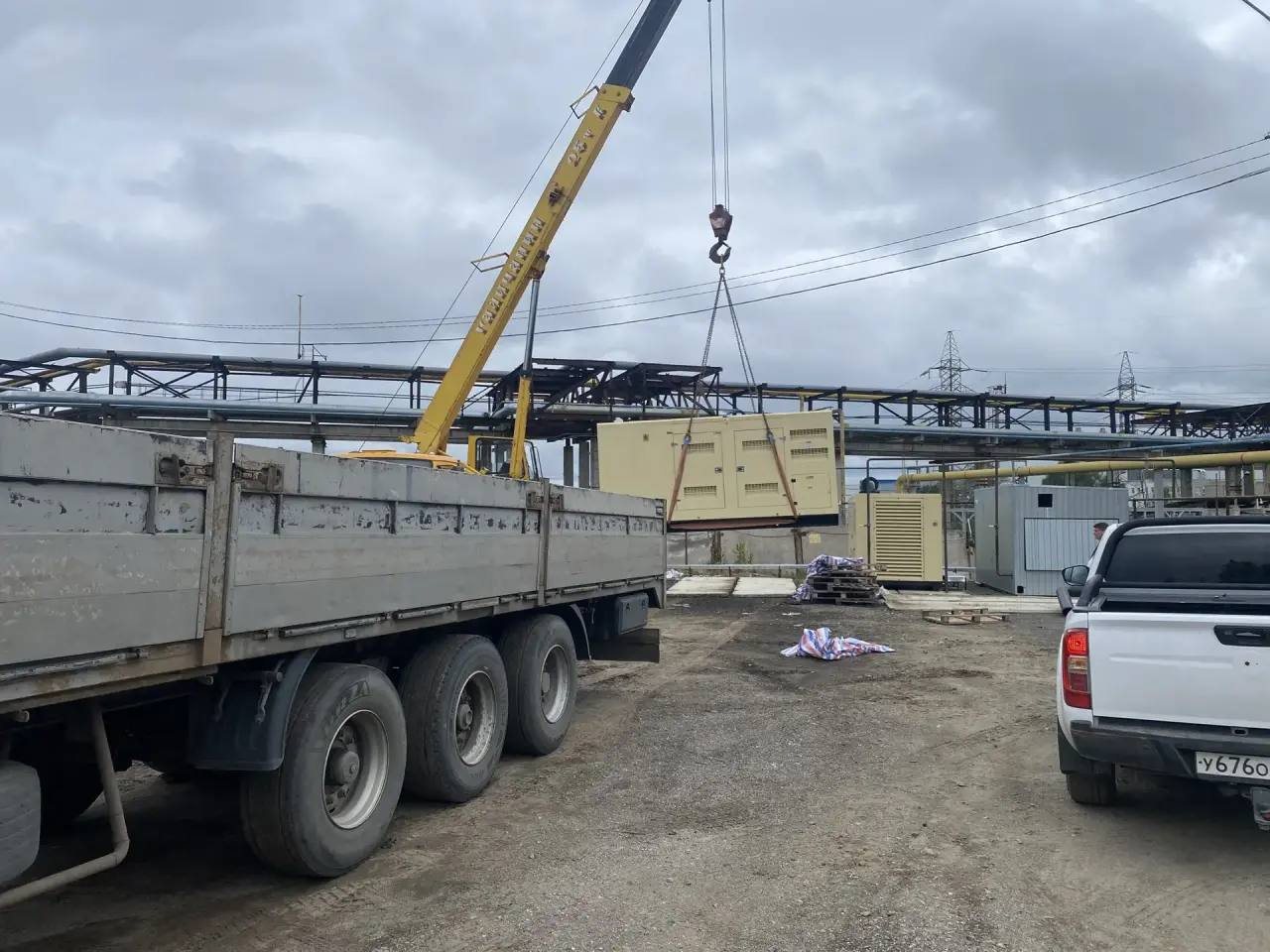
- Access for heavy vehicles: the genset arrives on a truck and is lifted off by crane.
Step 4: design and documents
The set of design documents depends on how the facility is classified and how it connects: island mode or parallel with the grid. Parallel operation is more complex: you need approval from the grid company and protections that disconnect the plant when the grid fails.
Every genset we supply comes with a document pack: a product passport with the full specification table, the installation and operation manual, the engine operation and maintenance manual in English and Russian, a maintenance schedule and parts replacement list for 60,000 operating hours, quality and origin certificates, a packing list with consumables and spare parts, and, for the canopy version, a canopy drawing with connection dimensions. The asset classification and customs codes your accountants ask for are stated in the supply documents.
How long it all takes
| Stage | Time |
|---|---|
| Selection and calculation for your site | 1–2 days |
| Delivery of units in stock | 30 days |
| Delivery of made-to-order units | 50–60 days |
| Installation and commissioning | From a few days, depending on site readiness |
| Gas, if the site has none yet | Months, planned separately |
Delivery times are for supply within Russia. Supply to other countries is discussed case by case.
On our largest site, 15 MW in the Saratov region, 75 days passed from the start of work to commissioning. That was possible precisely because gas and site preparation ran in parallel with delivery, not after it. See the 15 MW case study.
Engineering design, installation and commissioningTell us the power you need and what the site is. We will work out the configuration, gas consumption and lead time.Installation and serviceFrequently asked questions
How much gas does a gas generator need per hour?
It scales with power: the Weichai WPG312 burns 54 m³/h at 200 kW, the WPG500 85 m³/h at 320 kW, a 1,200 kW unit 310 m³/h. Multiply by operating hours and check against your allocated gas volume.
Can a gas generator be installed outdoors?
Yes, in a sound-attenuated canopy or a container. An open-frame unit is meant for indoor installation.
What documents come with the genset?
A product passport, installation and operation manual, engine manual in English and Russian, a maintenance schedule for 60,000 operating hours, quality and origin certificates and a packing list with spare parts.
Read next
This article is an English adaptation of our Russian original (Aug 17, 2026), rewritten for international readers. Prices are in RUB incl. VAT for supply in Russia; USD amounts are for reference only. Contracts are signed with TDM LLC (INN 9726051386) under Russian law, in RUB. Figures are estimates, not a public offer or a guarantee of income.