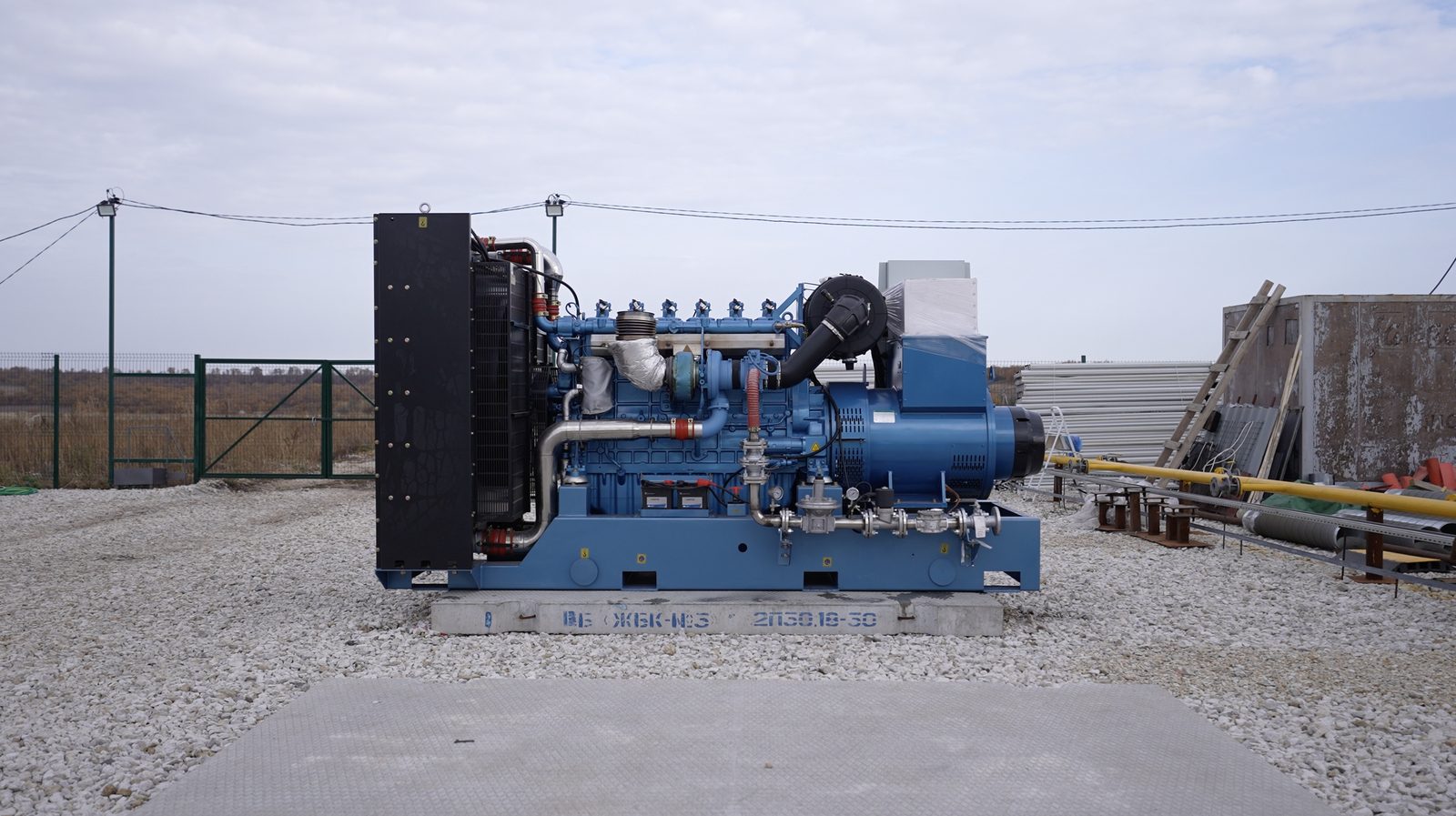
- Gas and air are mixed, compressed and ignited by a spark plug; the crankshaft turns a synchronous alternator.
- Industrial gensets run at 1,500 rpm to deliver 50 Hz.
- Electrical efficiency is about 40%; with heat recovery, total efficiency reaches 80–90%.
- Gas is for continuous power; diesel is for backup.
What happens inside
Gas is mixed with air, the mixture is compressed in the cylinder and ignited by a spark plug. The expanding gases push the piston, and the piston turns the crankshaft through the connecting rod. The shaft is coupled to the rotor of a synchronous alternator, and rotation becomes three-phase 400 V power.
Grid frequency in Russia is 50 Hz, and it is tied to engine speed. That is why industrial gensets run at 1,500 rpm: with four pole pairs on the alternator that gives exactly 50 Hz. The governor holds the speed. As soon as the load rises, it adds gas; otherwise the frequency would sag.
What a genset is made of
- Engine. In-line on smaller units, V-type on larger ones. The Weichai WPG312 has an in-line six of 12.54 liters; the WPG625 has twelve cylinders in a V.
- Alternator. Synchronous, brushless, with an automatic voltage regulator (AVR). The WPG312 and WPG500 use ENGGA alternators; larger Weichai models use Leroy Somer.
- Frame and anti-vibration mounts. Engine and alternator are rigidly coupled on a common frame; otherwise vibration destroys the bearings.
- Cooling system. A radiator with a fan, or a remote radiator if the genset stands indoors.
- Controller. Start, synchronization with the grid or other units, protections and an alarm log. The WPG312 and WPG500 come with a DSE8610; other models and projects use ComAp or DEIF.
- Gas train. Filter, pressure regulator and shut-off valves bring the gas pressure and cleanliness to what the engine needs.

Where the energy of the gas goes
Less than half of it becomes electricity. You can work this out from the datasheet: the Weichai range burns 0.23–0.27 cubic meters of gas per kWh, and a cubic meter of natural gas holds about 10 kWh of heat. Divide one by the other and you get an electrical efficiency of about 40%.
The remaining 60% is heat: in the exhaust, in the jacket water, in the oil. If it is released into the air, it is simply lost. If heat exchangers capture it for heating or hot water, the genset becomes a cogeneration (CHP) unit and total efficiency reaches 80–90%. This makes sense where heat is really needed all year: production, greenhouses, a settlement. More in cogeneration and heat recovery.
Gas vs diesel
| Gas genset | Diesel genset | |
|---|---|---|
| Fuel | Pipeline natural gas, associated petroleum gas, LPG (propane-butane) | Diesel fuel |
| Cost per kWh | Several times lower with your own gas supply | Tied to the diesel price |
| Ramp to full load | Smooth, tens of seconds | Almost immediate |
| Best for | Continuous 24/7 operation | Backup and emergency power |
| What the site needs | Gas supply of the right volume | A fuel tank |
Hence a simple rule: diesel is for getting through an outage, gas is for producing power continuously. That is why mining sites run gas gensets and keep diesel as backup.
And compared with a gas turbine?
A turbine wins at large capacities and steady load: from several megawatts at a flat output it is more efficient. A gas engine handles variable load better, starts and stops more easily and costs less per installed kW up to several megawatts. For a 0.2–3 MW site with daily swings in consumption, the choice is almost always a reciprocating gas engine.
Where gas gensets are used
- Bitcoin mining: power generation is the production itself, not an auxiliary system, so the rate decides everything. See gas generators for Bitcoin mining.
- Industry: a plant where a grid outage costs more than the genset. See industrial power.
- Oil production sites: associated petroleum gas that would otherwise be flared, after treatment by our partners. See associated petroleum gas.
- Greenhouses: heat is needed there too, so cogeneration pays off.
Frequently asked questions
How does a natural gas generator work?
A gas engine burns a gas-air mixture ignited by spark plugs. The crankshaft turns a synchronous alternator at 1,500 rpm, which produces three-phase 400 V power at 50 Hz. A controller and governor keep voltage and frequency stable.
What is the efficiency of a gas generator?
About 40% electrical efficiency for the Weichai range (0.23–0.27 cubic meters of gas per kWh). With heat recovery from exhaust and jacket water, total efficiency reaches 80–90%.
Can a gas generator run 24/7?
Yes, that is what it is built for. The Weichai range runs 60,000 operating hours to major overhaul, with scheduled maintenance every 500–1,000 hours depending on the model.
Read next
This article is an English adaptation of our Russian original (Aug 17, 2026), rewritten for international readers. Prices are in RUB incl. VAT for supply in Russia; USD amounts are for reference only. Contracts are signed with TDM LLC (INN 9726051386) under Russian law, in RUB. Figures are estimates, not a public offer or a guarantee of income.