- Start with the power source: own generation, a direct utility contract or resold capacity. Everything else follows from it.
- Compare the full monthly bill for your exact ASIC models, not the headline rate per kWh.
- The rate, its term and the conditions for changing it must be written in the contract.
- In Russia, check that the site is outside the regions where mining is restricted and that the operator is in the Federal Tax Service (FNS) register.
- Walk away from anyone who promises income: it depends on the Bitcoin price and network difficulty, not on the site.
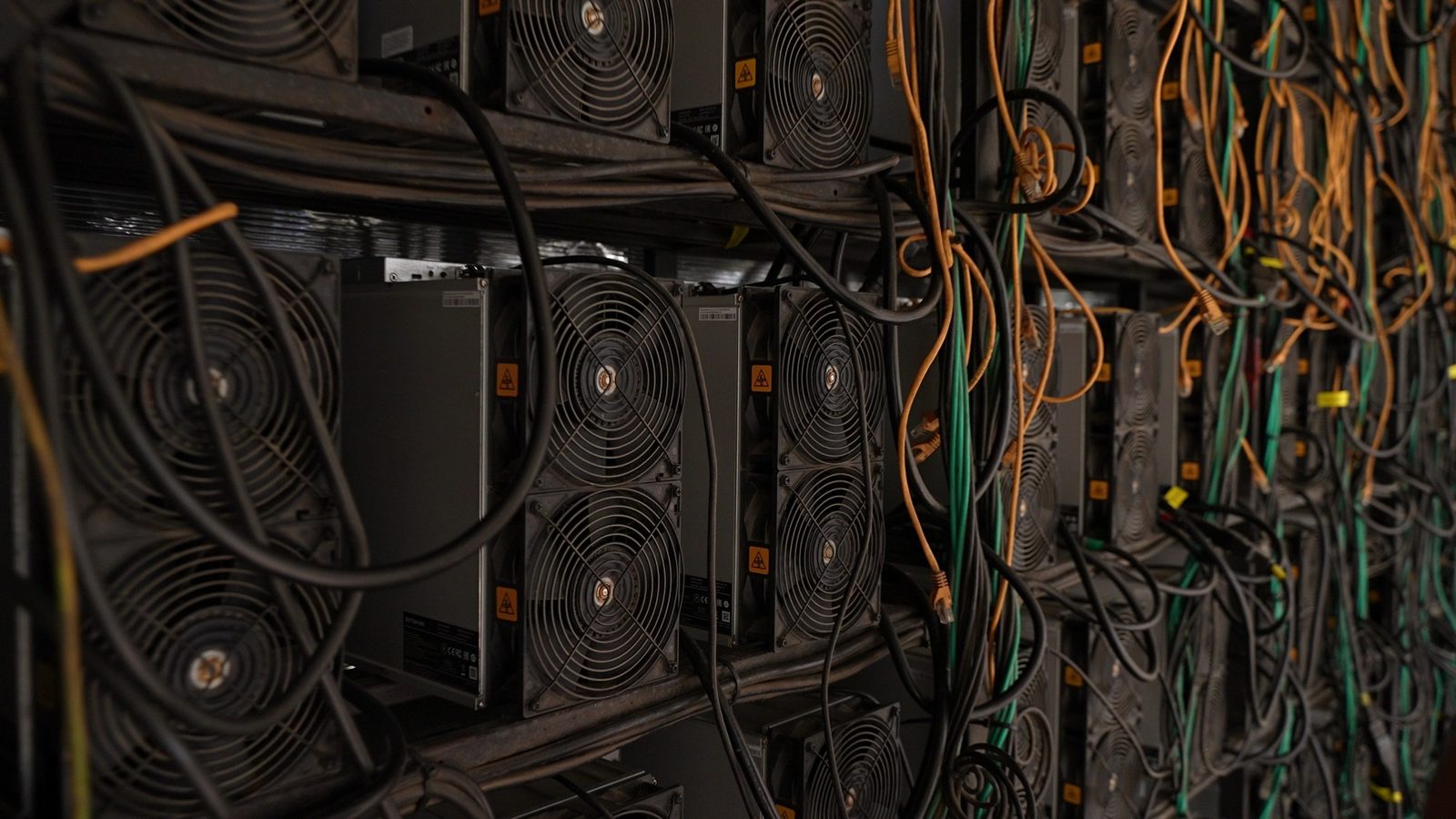
The service goes by many names: mining hosting, ASIC hosting, colocation, a mining data center. The idea is the same. You ship your own equipment to someone else's site and pay for power and maintenance. Your machines stay your property, mine to your pool and pay to your wallet. Sites differ not by the sign on the gate but by their answers to a few uncomfortable questions.
Why not run the machines yourself? One ASIC draws 3–3.5 kW and makes about 75 dB of noise around the clock. Ten of them need 35 kW of industrial power and industrial ventilation. In Russia, mining is also regulated: a legal entity needs a contract, VAT documents and an operator listed in the FNS register.
1. Where does the power come from?
This is the main question, and almost everything else follows from it. There are three options: the site's own generation, a direct contract with a utility, or someone else's capacity resold to you. With its own generation, the site controls the cost of a kWh. With a direct contract, it depends on the grid tariff, but at least without middlemen. In the third case, a chain of intermediaries stands between you and the electricity, and every price increase is passed on to you.
The difference is structural. A site that buys power from a utility cannot sell it cheaper than it buys it, and the grid tariff for mining in Russia starts at about 5.7 RUB/kWh. A site on its own gas generation is limited by its production cost instead. See what a kWh of own gas generation costs and how gas-powered Bitcoin mining works at our sites.
Ask it plainly: "Is the power your own or do you buy it? Show me the connection documents." A site that works by the book answers without a pause.
2. What is included in the rate, and what will be billed separately?
A low price per kWh means nothing until you know what is in it. Go through the components with the sales manager: rack space, cooling, internet and monitoring, security, repairs, replacement of power supplies and fans. Quite often these turn out to be separate lines, and a site at 3.5 RUB/kWh ends up more expensive than one at 4.5 RUB/kWh. The rate itself matters too: between 3 and 6 RUB/kWh, a fleet of 100 machines at 3.5 kW pays about 756,000 RUB more per month.
Here is how we answer that question. Our rate is 5 RUB/kWh incl. VAT, all-inclusive, billed by the meter. A month is 720 hours (30 days).
| ASIC | Power | Monthly bill incl. VAT | ≈ USD |
|---|---|---|---|
| Bitmain Antminer S21 XP | 3,645 W | 13,122 RUB | ≈ $160 |
| Bitmain Antminer S21 Pro+ | 3,510 W | 12,636 RUB | ≈ $154 |
| Bitmain Antminer S21++ | 3,878 W | 13,961 RUB | ≈ $170 |
| MicroBT Whatsminer M60S++ | 3,534 W | 12,722 RUB | ≈ $155 |
At 5 RUB/kWh × nameplate power × 720 h; the actual bill follows the meter. Promotional rate: 4.8 RUB/kWh incl. VAT until December 31, 2026, from 10 devices or 30 kW, air-cooled machines only. ≈ $ at the Central Bank of Russia rate of 82.15 RUB/USD as of Nov 14, 2026. Contracts and payments in RUB.
3. Is the rate fixed in the contract?
A rate quoted in a chat is worth nothing. The contract must state the rate, the period it is fixed for, and the conditions under which it can change. A clause such as "the operator may revise the price unilaterally" means there is no price at all, only an intention.
4. Is it legal: region, register, documents
From August 15, 2026 to December 31, 2032, mining is banned in Moscow, the Moscow region and eight districts of the Kursk region; in total, restrictions apply in fifteen regions. The site must be located where mining is allowed, and its operator must be listed in the Federal Tax Service (FNS) register of mining infrastructure operators. This can be verified; do not take it on trust. More in is mining legal in Russia.
Ask separately about your own documents: who signs the contract, how VAT is handled, what closing documents (invoices and acceptance certificates) you receive. You will need them when you register the equipment and when you sell it, and they cannot be restored later. With us, contracts are signed with TDM LLC under Russian law, in RUB. Clients outside Russia are handled case by case; please check the rules of your jurisdiction, including sanctions, with your counsel.
5. Who is responsible if an ASIC breaks?
ASICs break: power supplies burn out, fans stop, hashboards fail. The question is not whether it happens but what happens next. Who repairs it, at whose cost, how long the machine stays idle, and whether you pay for power while it is down. "We will ship it back to you" is not a service, it is a refusal of one. See how we put this in writing: contract and liability.
6. What stands behind the uptime figure?
Everyone quotes an uptime number. It only means something with an explanation behind it: what happens when the power input fails, whether there is redundancy, how long a restart takes. And above all, what happens if the promised figure is not met: compensation, recalculation or nothing.
7. Can you see your machines?
A proper site gives you monitoring access: hashrate, temperatures, the status of each machine. Without it, you learn about downtime from a report at the end of the month, with nothing to check how long it actually lasted.
8. Distance and logistics
The honest answer is sometimes not in our favor. If you have ten ASICs and a site in your own city, it is more sensible to put them there: being able to drive over and look is worth more than a rate difference of 1.5 RUB per kWh. A remote site wins on volume, when a year of savings on the rate covers both the shipping and the fact that you cannot drop in at any time. For clients outside Russia, shipping and customs are discussed case by case.
9. What happens when you want your equipment back?
Ask in advance: the notice period, how equipment is released, who pays for dismantling and packing. The question is unpleasant and therefore telling: the reaction to it says more about a site than the whole presentation.
Red flags: when to walk away
- They will not name the site address and refuse a visit.
- The rate is below market with no explanation of where the power comes from.
- There is no contract, or they offer to work on a handwritten receipt.
- The operator is not in the FNS register, and the question is laughed off.
- They promise income. Income depends on the Bitcoin price and network difficulty, not on the site, so no one can promise it.
- They ask for a full year's prepayment in the first conversation.
- Stock photos of data centers instead of real photos and figures from their sites.
How to use these questions
Send them to three sites at once and compare not the answers but how they are given. Where everything is in order, the answers are specific and fast, because they are given every day. Where you hear "it depends" and "let's discuss it in person", that is usually exactly what you were looking for with these questions.
Our answers to these nine questionsOur own gas-fired generation in the Saratov region, hosting at 5 RUB/kWh incl. VAT and 3.75 RUB/kWh with your own genset, the rate fixed in the contract, sites in a region without restrictions, operator in the FNS register.Hosting termsFrequently asked questions
What is mining hosting?
A site where you place your own ASIC miners and the operator provides power, cooling, internet, security and repairs. The machines stay yours, mine to your pool and pay to your wallet.
How much does ASIC hosting cost in Russia?
Our rate is 5 RUB/kWh incl. VAT, all-inclusive, billed by the meter; with your own gas genset at our site it is 3.75 RUB/kWh. Grid power for mining in Russia starts at about 5.7 RUB/kWh, so sites that resell grid power rarely go below that.
Can a foreign company host ASICs in Russia?
Contracts are signed with TDM LLC under Russian law, in RUB. Clients outside Russia are handled case by case. Please check the rules of your jurisdiction, including sanctions, with your counsel.
Does a hosting provider guarantee mining income?
No honest provider does. Income depends on the Bitcoin price and network difficulty. A site can only commit to its rate, its service and the uptime terms written in the contract.
Read next
This article is an English adaptation of our Russian original (Aug 19, 2026), rewritten for international readers. Prices are in RUB incl. VAT for supply in Russia; USD amounts are for reference only. Contracts are signed with TDM LLC (INN 9726051386) under Russian law, in RUB. Figures are estimates, not a public offer or a guarantee of income.