Samara: three open-frame gensets in a sound-insulated building
Three Weichai gas generator sets were bought as open frame, without canopy or container. Noise is handled not by a factory enclosure but by the building itself: a permanent structure lined with mineral wool, with ventilation grilles in the openings and exhausts through the roof. This route is cheaper and quieter than canopies, but only if the building is designed together with the gensets, not around units already in place.
What stands on the site
Open frame: the units have neither canopy nor container; they stand on their frames inside the building.
400 kW PRP (320 kW continuous) each, open frame. Weichai (Baudouin) 6M33D450E310NG engine, ENGGA alternator. Maintenance every 500 operating hours, 60,000 operating hours to major overhaul.
Walls and roof lined with mineral wool under metal cladding, ventilation grilles for intake and exhaust air. Each unit's exhaust leaves through the roof in its own stack.
From loading to sound insulation
Five steps in the order they happened. The videos are our own footage from the site.
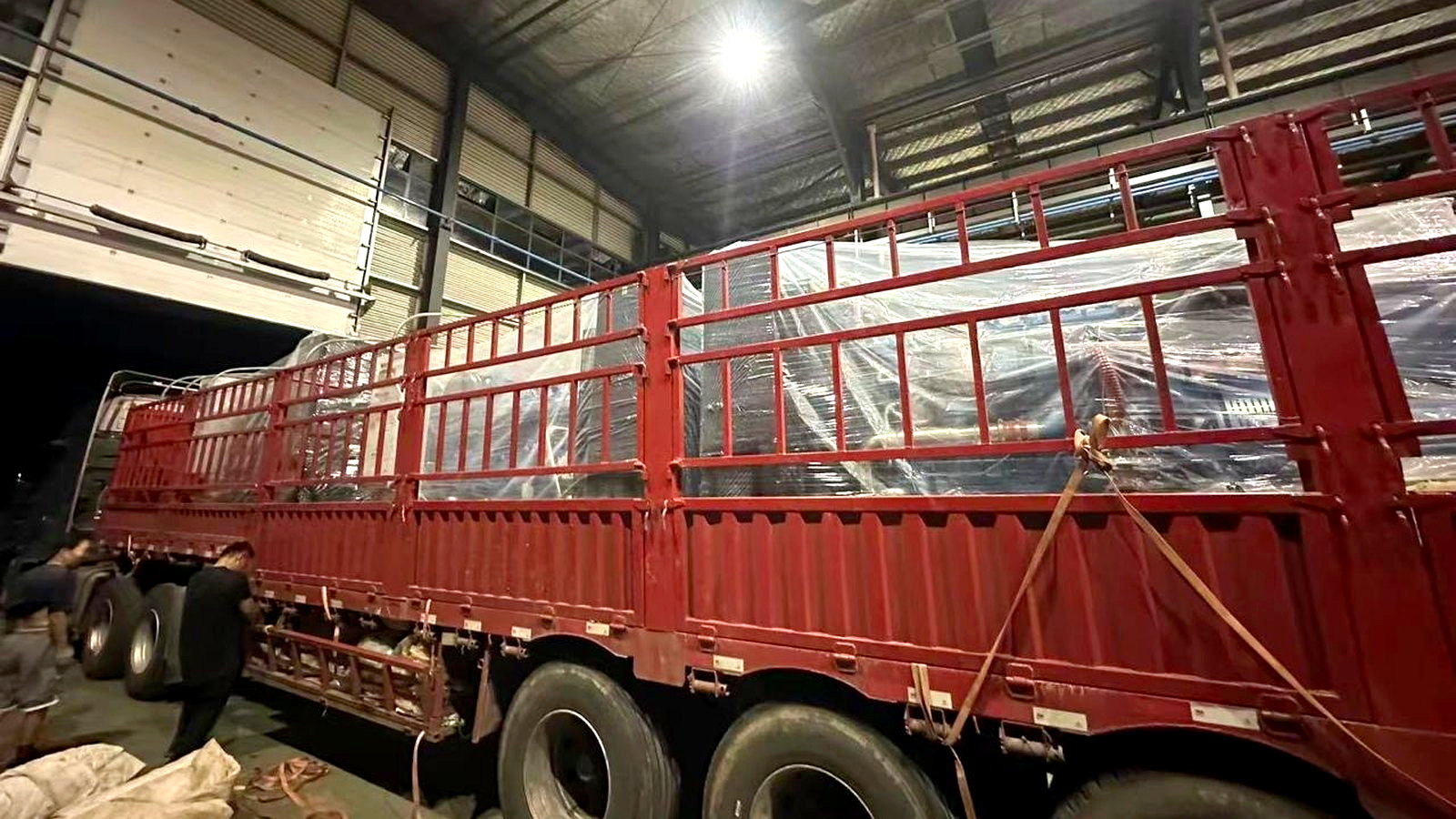
Night loading of the gensets for this project: units wrapped in film and strapped to a flatbed trailer. They travel as open frames: three canopies cost more than one building, and a bare frame is more compact on a truck.
Lead time for our Weichai range is 30–60 days depending on the model. In transit the unit is held by its own frame: it is secured and rigged by the frame, not by body parts.
Supply with a Russian customs declaration (GTD), VAT and a full document set. Three results at once: the unit goes on the balance sheet legally, VAT is reclaimable, and there is a basis for warranty claims.
The video shows both stages in one take: first the gensets on frames under a roof, some still in factory film, with no building around them; then the same place with the enclosure finished. Each unit has its own exhaust: three cannot share one manifold, or a running unit would push gases into a stopped one.
Mineral wool in the walls and roof under metal cladding, grilles in the openings for intake and exhaust air. Air moves through the grilles, not through open gates; otherwise the gain from insulation is lost in the first opening.
In operation
- Units on open frames: access to components without removing canopy panels
- Intake and exhaust air through grilles; the engine room gates stay closed during operation
- Each unit's exhaust in its own stack through the roof, with a silencer
Not yet published: investment, power cost, number and model of ASICs, actual delivery time, launch month and measured noise at the site boundary.
Questions
Why not gensets with canopies, if quiet operation was needed?
Because there are three units in one place. A canopy is sound insulation paid for on every unit separately; a building is built once for all three and is quieter, because there is a wall between the engine and the street, not a panel with insulation. For a single unit in open country the answer would be the opposite: a canopy is cheaper and faster.
How much quieter does such a building make it?
We did not measure this site, so we will not quote a figure. As a guide, a factory canopy gives about 75 dB(A) at 7 meters; a permanent wall with mineral wool and well-made grilles gives noticeably less. The exact value depends on insulation thickness, grille design and the exhaust, and is calculated for each site.
Can a genset go into an existing building?
Often yes, but it is a separate job: intake and exhaust air for full power, an exhaust outlet through the roof or wall, heat removal, a gas line and service space around the unit. A room that was not designed for this needs rework, and sometimes that costs more than a containerized unit next to it.
Open frame, canopy or container: which suits my site?
It depends on the number of units and whether there is a building. One unit and no building: canopy or container. Several units side by side and the option to build: open frame plus a building, as here. A site you may have to move: container only. Send us the power and site conditions and we will price all three options.
Other projects

Related
Talk to the team
We answer in English. Tell us what you are looking for (hosting, equipment or an investment) and we will come back with numbers, documents and, if you wish, a video tour or a site visit.