Heat recovery systems for gas generator sets
A heat recovery system takes the heat a gas genset already produces and sends it to heating, hot water or processes: about 1 kW of heat per kW from the exhaust, up to 1.45 kW with jacket water.
A gas genset turns about 40% of the energy in the gas into electricity. Most of the rest leaves as heat through the exhaust and the radiator. A heat recovery system puts this heat to work: an exhaust heat recovery boiler, heat exchangers and controls. You have already paid for this heat with the gas.
By default we offer the exhaust boiler alone. It goes on the exhaust line with a bypass damper and does not touch the engine cooling system. Jacket water recovery adds 0.4–0.5 kW of heat per kW but needs much more work; it pays off on stations from about 800 kW.
Where the heat of a genset goes
450–550 °C, cooled to 120 °C in the boiler. The hottest and most accessible source: the boiler goes on the exhaust line and the engine is not touched. Water at 95 °C and above, steam if needed.
80–95 °C. Less heat and more work: a heat exchanger is built into the engine cooling system. Justified on stations from 800 kW.
70–90 °C. Goes into the same circuit as the jacket water and is not recovered separately.
40–60 °C. Low-grade heat for floor heating and greenhouses; usually dumped.
Four types of heat recovery system
Boiler, bypass damper and control cabinet: ≈ 1 kW of heat per kW of rated power. The damper sends the exhaust through the boiler when heat is needed and past it when it is not. Our default for stations up to 800 kW.
Plate heat exchanger, piping, a motorized three-way valve and shut-off valves: ≈ 0.4–0.5 kW of heat per kW. For stations from 800 kW, together with the exhaust boiler.
Both circuits with common controls: ≈ 1.4–1.5 kW of heat per kW. An emergency radiator cools the engine when the heat consumer is off. For large stations with year-round heat demand.
An absorption chiller turns heat into cooling in summer: for warehouses, workshops and food production.
Exhaust boiler or jacket water: a 250 kW unit
| Exhaust heat recovery boiler | Jacket water heat exchanger | |
|---|---|---|
| Heat | ≈ 250 kW | ≈ 100–120 kW |
| Equipment, incl. VAT | 1,056,000 RUB≈ $12,900 | 1,020,000 RUB≈ $12,400 |
| Per kW of heat, equipment | 4,200 RUB≈ $51 | 9,300 RUB≈ $113 |
| What is installed | Boiler on the exhaust line, bypass damper, control cabinet | Heat exchanger, piping, motorized three-way valve, shut-off valves |
| Engine involvement | None: exhaust only | Yes: the engine cooling circuit |
| Where it goes | On the exhaust line, outdoors or on the container roof | Inside the container, sometimes with refitting |
Jacket water figures are approximate. Below 800 kW we recommend the exhaust boiler alone: about twice the heat for comparable money, and the engine is not touched.
Prices
| Item | Price, incl. VAT | What it covers |
|---|---|---|
| Exhaust boiler for the Weichai WPG312250 kW (200 continuous) | 1,056,000 RUB≈ $12,900 | Boiler on the exhaust, bypass damper, control cabinet |
| Exhaust boiler for the Weichai WPG500400 kW (320 continuous) | 900,000 RUB≈ $10,960 | Boiler on the exhaust, bypass damper, control cabinet |
| Exhaust boiler for the Weichai WPG625625 kW (500 continuous) | 1,500,000 RUB≈ $18,300 | Boiler on the exhaust, bypass damper, control cabinet |
| Exhaust boiler for a 250 kW unit, from 5 units | 996,000 RUB≈ $12,120 | Price per boiler from the standard range for Weichai. |
| Installation per unit, approx. | 1,020,000 RUB≈ $12,400 | Or by your own fitters: welding and plumbing work. |
| 1 MW station: exhaust and jacket water, approx. | 3,430,000 RUB≈ $41,800 | Equipment only; installation is quoted for the site. |
Guide prices for clients; the final price follows the specification for your site. The heat circuit of the building (pumps, piping, connection) is quoted separately. Genset and boiler as one package: gas engine CHP plants. ≈ $ at the Central Bank of Russia rate of 82.15 RUB/USD as of Nov 14, 2026. Contracts and payments in RUB.
How much floor area 250 kW of heat covers
| Region or building | Heating demand | Floor area |
|---|---|---|
| South of Russia (Saratov, Samara, Rostov) | 80 W/m² | ≈ 3,130 m² |
| Central Russia (Moscow, Yaroslavl) | 100 W/m² | ≈ 2,500 m² |
| North (Vologda, the Urals) | 120 W/m² | ≈ 2,080 m² |
| Old Soviet-era buildings | 160 W/m² | ≈ 1,560 m² |
| Greenhouse in winter | 400 W/m² | ≈ 630 m² |
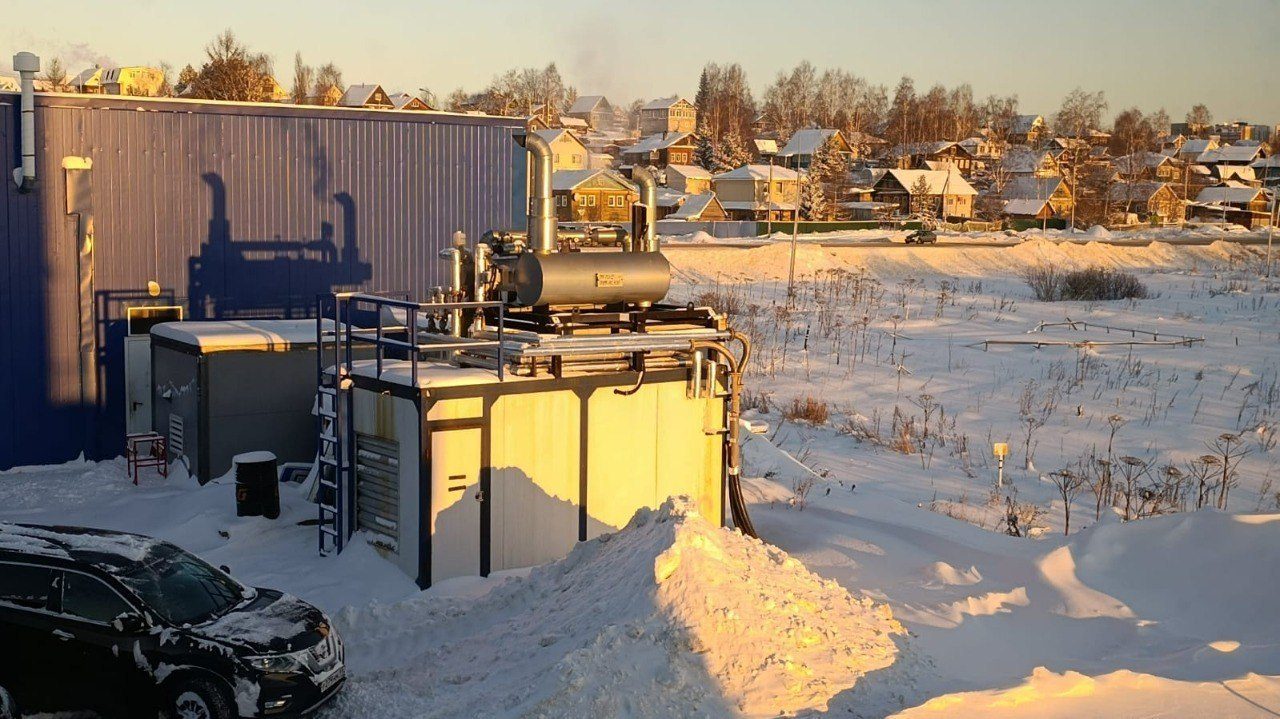
A rough guide for space heating. We calculate the real demand from the building type, the schedule and hot water needs. How it looks on a real site: 250 kW genset with exhaust heat recovery, photo report (in Russian).
What is in the kit
From brief to commissioning
What we heat: floor area, building type, region, hot water or steam, how many months a year.
We compare the site's demand with what the station gives: whether the exhaust boiler is enough or jacket water recovery is needed too.
Scope of supply, materials and passport data, so it is clear what the price is for.
A boiler from the standard range for Weichai; installed by our crew or by your fitters.
Damper and controls set up, temperatures and back pressure checked, staff trained.
Design rules
Below the dew point, acid condensate forms in the boiler and eats the tubes. The controls hold the outlet temperature.
When heat is not taken, the damper sends the exhaust past the boiler and the genset runs as usual. With jacket water recovery an emergency radiator is needed as well.
The boiler adds resistance to the exhaust line. It is kept within the engine's limit, usually no more than 3 kPa.
A figure like 250 kW of heat says little on its own. We need the floor area, building type, region, schedule and whether hot water is required: this shows whether the heat is enough.
Hard water without treatment scales the boiler within a season and cuts the heat output.
Payback is counted on the months when the heat is really used. In summer: hot water, processes or trigeneration.
A site in the Moscow region: the exhaust heat recovery unit sits on the roof of a winterized container with a 250 kW genset. A winterized container is not an option there: the boiler and piping work outdoors all year.
Related pages
Case studies and articles
Questions
What is a heat recovery system for a gas genset?
An exhaust heat recovery boiler, heat exchangers and controls that take the heat of a gas genset, first of all from the exhaust, and send it to space heating, hot water or processes. Without it this heat goes up the stack and into the radiator. A genset with such a system is called a cogeneration unit or a small CHP plant.
How much heat does a gas genset give?
An exhaust boiler recovers about 1 kW of heat per kW of rated power: a 250 kW unit gives about 250 kW of heat, about 0.21 Gcal per hour or 5.2 Gcal a day. Jacket water recovery adds another 0.4–0.5 kW per kW.
What floor area can 250 kW of heat cover?
Divide 250,000 W by the heating demand per square meter. South of Russia (Saratov, Samara, Rostov), 80 W/m²: about 3,130 m². Central Russia (Moscow, Yaroslavl), 100 W/m²: about 2,500 m². North (Vologda, the Urals), 120 W/m²: about 2,080 m². Old Soviet-era buildings, 160 W/m²: about 1,560 m². Greenhouse in winter, 400 W/m²: about 630 m².
Why not recover the jacket water heat as well?
On a 250 kW unit a jacket water heat exchanger gives 100–120 kW of heat and costs about 1,020,000 RUB for the equipment. It needs piping, a motorized three-way valve, shut-off valves and space in the container. An exhaust boiler for comparable money gives about twice as much heat and does not touch the engine cooling system. Jacket water recovery makes sense from about 800 kW.
How much does a heat recovery system cost?
An exhaust heat recovery boiler for a 250 kW unit with a bypass damper and a control cabinet: 1,056,000 RUB incl. VAT, 996,000 RUB each from 5 units. For the WPG500 (400 kW): 900,000 RUB; for the WPG625: 1,500,000 RUB. Installation is about 1,020,000 RUB per unit, or your own fitters can do it. A 1 MW station with exhaust and jacket water recovery: about 3,430,000 RUB for the equipment. The final price follows the specification for your site.
Can it be added to a genset that is already running?
The exhaust boiler, yes: it is the simplest retrofit, a cut into the exhaust line, a damper and a cabinet. Jacket water recovery is harder: it needs space and changes to the cooling circuit, so it is better planned into the project from the start.
What happens in summer when heat is not needed?
The damper sends the exhaust past the boiler and the genset runs as usual. If heat is needed in summer too: hot water, processes or an absorption chiller that turns heat into cooling.
Is heat recovery worth it on a mining site?
Usually not. In winter the ASICs already give more heat than needed, in summer the circuit is idle. The exception is a heat consumer next door.
How long does the system last?
A stainless steel boiler with the exhaust leaving at no less than 120 °C lasts as long as the genset. Systems fail most often without water treatment or with the exhaust cooled below the dew point.
Talk to the team
We answer in English. Tell us what you are looking for (hosting, equipment or an investment) and we will come back with numbers, documents and, if you wish, a video tour or a site visit.