- J/TH is the energy a miner spends per terahash. Lower is better.
- Revenue per terahash is the same for every machine on the network; only the power bill differs.
- At 5 RUB/kWh, an Antminer S19 (34 J/TH) loses money and an S21 XP (13.5 J/TH) keeps about half of its revenue.
- Breakeven efficiency = revenue per TH/s per day ÷ (rate × 0.024).
- Figures are an estimate on August 2026 network data, not a guarantee of income and not a public offer.
What J/TH means
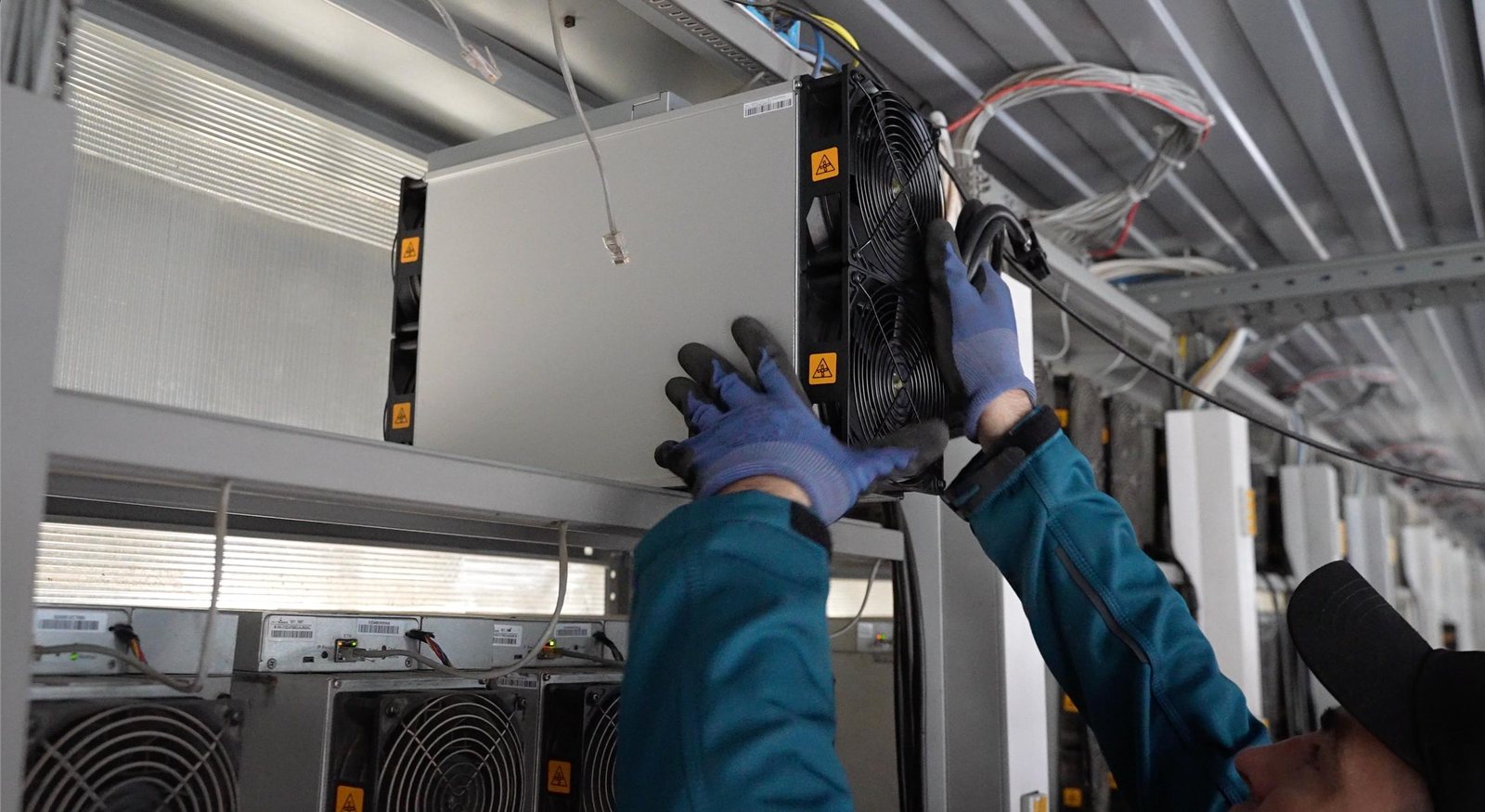
Joules per terahash is how much energy a machine spends on one terahash of computation. It is the same as watts per terahash per second, which is why datasheets show both J/TH and W/TH: it is one number. The Antminer S9 of 2017 is 98 J/TH, the S19 is 34, the S21 XP is 13.5, the S23 Hyd is 9. The lower the figure, the cheaper each terahash.
Why hashrate does not answer "is it profitable?"
Hashrate sets revenue: more terahashes, more coins. But revenue per terahash is the same for every machine on the network. At August 2026 difficulty and a Bitcoin price of $63,800, it was about 2.9 RUB per TH/s per day. An S9 or an S23, a terahash is a terahash.
What differs between machines is the bill for that terahash. It takes one line: J/TH × 24 / 1000 is the kWh a terahash consumes per day. Multiply by your rate and you see how much of the 2.9 RUB goes to electricity. Whatever remains is profit. Hashrate does not appear in this formula at all.
Two machines at 5 RUB/kWh
| Antminer S19 | Antminer S21 XP | |
|---|---|---|
| J/TH | 34 | 13.5 |
| kWh per TH/s per day | 0.816 | 0.324 |
| Power cost at 5 RUB/kWh | 4.08 RUB | 1.62 RUB |
| Revenue per TH/s per day | ≈ 2.9 RUB | ≈ 2.9 RUB |
| What is left | − 1.18 RUB | + 1.28 RUB |
At 5 RUB/kWh the S19 runs at a loss, whatever its hashrate and whatever you paid for it. A used S19 for 30,000 RUB looks like a bargain until the first power bill. The S21 XP pays a little over half its revenue for electricity and leaves the rest to the owner.
Breakeven efficiency: one number for your rate
Divide revenue per terahash by your rate and by 0.024, and you get the J/TH at which a machine breaks even. At 7 RUB/kWh from the grid, the threshold is about 17 J/TH: only the newest generation is in profit. At 5 RUB/kWh at a hosting site with its own generation, it is about 24: the S21, S21++, M60S and M61 work. At 3.75 RUB/kWh with your own genset, it is about 32: even the S19 survives.
How efficiency has changed
| Model | Year | J/TH |
|---|---|---|
| Antminer S9 | 2017 | 98 |
| Antminer S17 | 2019 | 40 |
| Antminer S19 | 2020 | 34 |
| Antminer S19 XP | 2022 | 21.5 |
| Antminer S21 | 2023 | 17.5 |
| Antminer S21 XP | 2024 | 13.5 |
| Antminer S23 Hyd | 2026 | 9 |
Every chip generation lowers J/TH, and every halving lowers revenue per terahash. A machine that was standard three years ago ends up above the threshold after the next halving. The ones with the highest J/TH are switched off first, and they are exactly the ones sold at the lowest prices just before that.
What to check when you buy
- J/TH at the wall, not at the chip: the power supply, fans and heat add 5–10% to the nameplate draw.
- Hashrate grows faster than the bill: 270 TH/s at 13.5 J/TH is 3.6 kW, 151 TH/s at 17.5 J/TH is 2.6 kW. That is 79% more hashrate for 38% more electricity.
- Hydro-cooled versions are 10–20% more efficient, but need a ready cooling loop at the site. We host hydro-cooled machines in Antspace containers; terms on request.
- A cheap used ASIC with a high J/TH gets more expensive every month, through the power bill.
Frequently asked questions
What is a good J/TH for a Bitcoin miner?
It depends on your power rate. With August 2026 revenue per terahash, the breakeven is about 17 J/TH at 7 RUB/kWh, 24 J/TH at 5 RUB/kWh and 32 J/TH at 3.75 RUB/kWh. This is an estimate, not a guarantee of income.
Are J/TH and W/TH the same?
Yes. A joule per terahash equals a watt per terahash per second, so both units give the same number.
Is a cheap used S19 worth buying?
At 5 RUB/kWh and August 2026 network data, an S19 at 34 J/TH spends more on electricity than it earns. It only makes sense at a rate of about 3.75 RUB/kWh or lower.
Read next
This article is an English adaptation of our Russian original (Sep 29, 2026), rewritten for international readers. Prices are in RUB incl. VAT for supply in Russia; USD amounts are for reference only. Contracts are signed with TDM LLC (INN 9726051386) under Russian law, in RUB. Figures are estimates, not a public offer or a guarantee of income.